
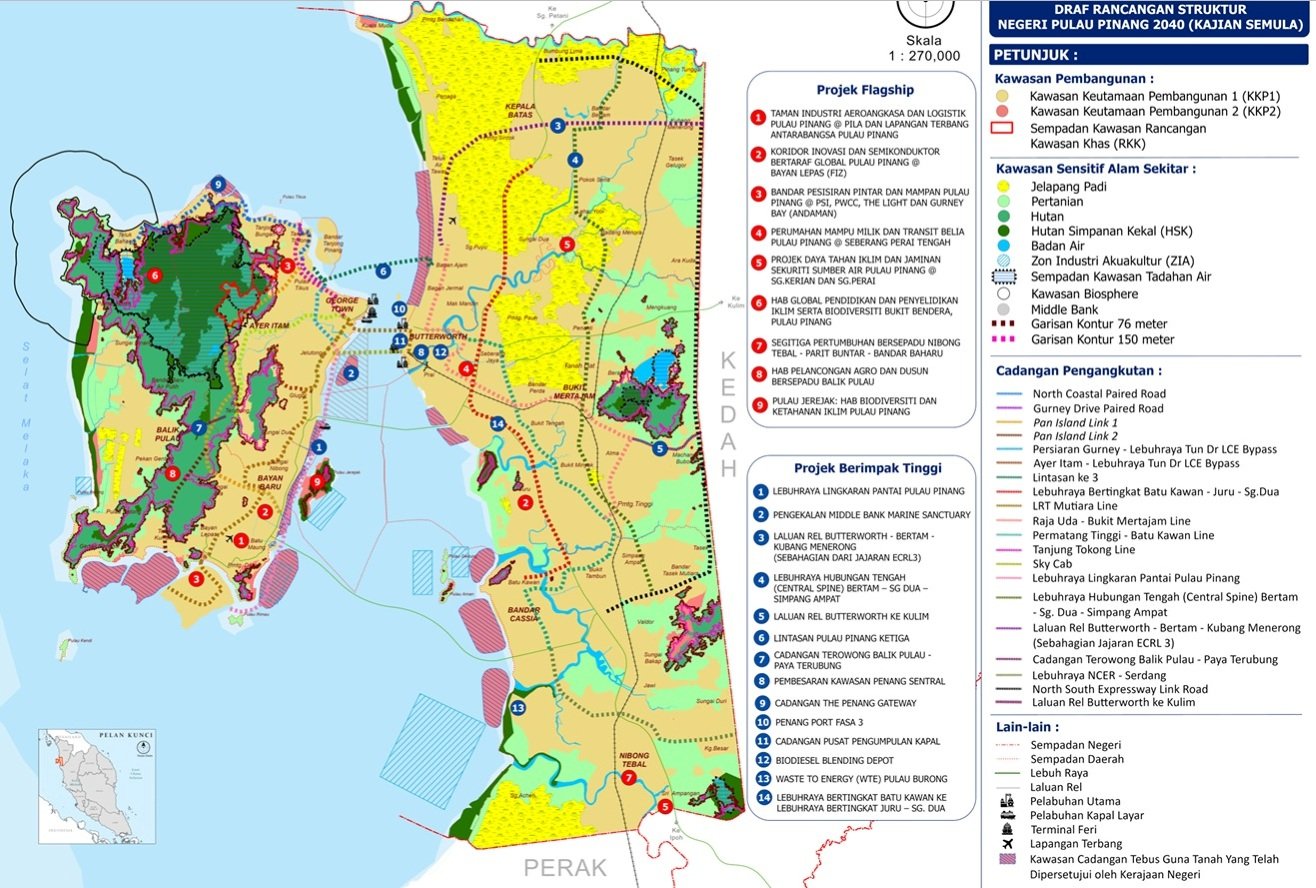
This plan, the draft Penang Structure Plan 2040, is already well in progress. It has been put up for public display and feedback – but chances are, most people in Penang are not even aware of it.
Look at it closely, and you will see that it looks like a developers’ and contractors’ dream. Plenty of ‘jobs for the boys’.
Lot of land reclamation sites all over – about 12 from the looks of it. That includes the ‘Penang Gateway’ (no. 9 on the map) reclamation project somewhere in Batu Ferringhi.
There appears to be a conflict in putting an earmarked reclamation project inside a zone that is supposed to be gazetted as a marine sanctuary – the unique Middle Bank seagrass strip in the Penang channel (no. 2 blue).
And look at all the reclamation and ‘development’ slated for the area around Jerejak Island (no. 9 red).
The SRS-proposed Islands B and C in the south are still on the map – despite previous reports that the project would be scaled down to just one island.
There’s another large reclamation site on the southeast of Penang Island.
And look at the half a dozen reclamation sites on the mainland.
Who are they building for, when the birth rate in Penang has shrunk well below population replacement level? Seems to me that Greed has taken over.
Check out a new coastal ring highway on the east coast (no. 1 blue). Do we really need more highways instead of more sustainable mobility?
The third crossing (the tunnel?) is still on the map (no. 6 blue). They never give up, do they?
More LRT links here and there but I don’t see much in the way of a “better, cheaper, faster” bus rapid transit and tram network. And where are the water taxi routes?
That’s not all. Why are they indicating a 150-metre contour line above sea level, when at present there is a limitation on development above 76 metres above sea level? It seems they want to allow development on hill slopes even exceeding 300 metres above sea level all the way up, subject to risk assessments.
Remember, after 18 years since the change in government in 2008, we still don’t have a more detailed local plan, which governs the permissible development and zoning densities allowed in your neighbourhoods. Why is that?
Meanwhile, most of the Penang public remain blissfully in the dark about what is in store for them.
| Please help to support this blog if you can. Read the commenting guidlelines for this blog. |
Witness the breathtaking evolution of Penang (George Town), Malaysia, in this stunning AI-generated time-lapse:
Saw this video earlier on YouTube, and it made me think about the first Penang Bridge, which was completed in 1985.
It is now 2026. Just look at the condition of the bridge today.
It looks dirty, no paint work or the paintwork appears poorly maintained, and the overall upkeep leaves much to be desired.
Elsewhere, we can see much the same problem.
Our maintenance culture is almost absent.
Maintenance (and budgeting for it) means less development (capital expenditure) in the medium term. Therefore, it is bad.
Over 50% of the island’s surface is covered by impervious materials, straining aging drainage systems and driving frequent flash floods during monsoons. While the state targets a 40% public transit modal share by 2030, current public transport usage hovers around 3%, heavily relying on private motor vehicles.
We like to present grand visions of what Penang could look like by 2050, but building something impressive is only one part of development.
Maintaining what we already have is equally important.
If we cannot properly maintain infrastructure that has already been built, it is difficult to believe that the beautiful 2050 vision shown in this video will actually look anything like this when the time comes.
At the present rate, don’t see it happening.
Penang Maximum 80% Maintenance Fund, commonly known by its Malay acronym TPM80PP (Tabung Penyelenggaraan Maksimum 80% Pulau Pinang) is a key housing assistance initiative introduced by the Penang State Government (initiated around 2010) to help maintain, repair, and upgrade both public and private strata housing schemes (such as low-cost and medium-cost apartments and flats).
The fund mentioned is for certain eligible housing schemes.
However, the concern goes beyond housing maintenance.
It is also about how well we maintain our existing infrastructure, manage public services and implement policies in practice.
This includes waste management, recycling, drainage, road maintenance and other essential services.
Having a policy or a fund in place is one thing. Ensuring that it works effectively in practice is another.
Penang is a small island.
Instead of constantly focusing on more construction and grand development plans, we should also ask whether we are properly maintaining what we already have and managing our existing public services effectively.
But are we actually doing this?
New Gurney Bay Centre: The existing food court and vendors from Anjung Gurney are scheduled to relocate to the new, modern hawker complex at Gurney Bay in the first quarter of 2027. The existing Kompleks Makanan Persiaran Gurney recently completed a RM455,055 facelift (including a new roof and lighting) and remains open during its transition phase.
Development should not be measured simply by how much concrete and mortar we can put up.
Penang needs responsible development, proper maintenance and effective public services – not construction for construction’s sake.
Penang has been selected as one of 25 global destinations in National Geographic’s Best of the World 2027, standing out as the only Malaysian and Southeast Asian city featured. The recognition highlights its blend of heritage, nature, and food.
World-Class Culinary Heritage in Penang is recognised. Following a dedicated NatGeo feature recognizing its food culture, Penang’s culinary scene—from street-side Char Koay Teow and Penang Assam Laksa to Nyonya spots like Auntie Gaik Lean’s Old School Eatery and contemporary fine dining like Au Jardin—remains a core draw.
Just south of Penang, the historic trading island off Malaysia’s north-west coast, excavators are turning a stretch of blue-green sea into a new, man-made island.
Once complete sometime next decade, this 930ha area, called Silicon Island, is expected to entrench Malaysia’s role in the global semiconductor industry, adding hundreds of billions of dollars to its economy and creating some 220,000 jobs by 2050.
https://www.straitstimes.com/asia/se-asia/malaysia-builds-a-new-silicon-island-to-house-its-ai-ambitions
The plans call for about 20,000 houses on 360 acres (145.7ha), including condominiums and affordable dwellings, alongside shops, amenities and restaurants. Almost one-fifth of the island will be green space, including parks, beaches and mangrove wetlands.
Silicon Island (Penang South Islands): A 2,300-acre ESG-compliant reclaimed island featuring the Green Tech Park for high-tech semiconductor and IC design industries, alongside housing, commercial hubs, and 17.5% dedicated green spaces, parks, and blue-green water networks.
physical reclamation has reached 202.3 hectares out of the total planned 930.77 hectares (about 21.7% of the total land size).
State-led urban greening programs, tree-planting guides, and nature-based climate adaptation strategies: As urban areas heat up, Penang’s push toward urban forests, pocket parks, and sustainable drainage solutions helps lower ambient city temperatures, combats urban flooding, and creates a healthier, cooler environment for pedestrians and residents.
Vehicle numbers have outpaced population growth severely. Reports indicate roughly 2.67 million registered vehicles for a population of about 1.8 million, choking key bridge and highway corridors. Need to introduce electronic road pricing?
Easy Access to Long-Term Car Loans allow young people to own cars:
– Up to 9-Year Loan Tenures: Malaysia offers some of the longest hire-purchase car loan repayment periods in the world (up to 9 years).
– Low Entry Barrier: This extended loan structure lowers monthly installments, allowing fresh graduates with starting salaries of around RM2,500 to RM3,000 to qualify for entry-level national cars like the Perodua Axia or Myvi.
The latest Singapore Certificate of Entitlement (COE) results from the first bidding exercise of October 7, 2026 are as follows:
– Category A (Cars ≤ 1,600cc & 130bhp): S$130,001 (Down $1,889)
– Category B (Cars > 1,600cc or 130bhp): S$130,100 (Down $2,900)
Aliran heavily relies on the premise that scaling up bus fleets and introducing dedicated lanes will naturally coax motorists out of their cars. Critics point out that Malaysia’s vehicle ownership culture and tropical climate make private vehicles a deep-seated preference. Without high-capacity, grade-separated transit that completely bypasses road traffic, incremental bus improvements historically fail to pull enough drivers out of traffic to make a dent.
There are just 300 buses in Penang, compared to several thousand (5,000 to 6,000?) buses in Singapore.
Aliran should factor in the high cost of car ownership in Singapore including the Certificate of Ownership (COE, which is at least S$100K, for 10 years of ownership), high fuel price, electronic road pricing (ERP). Singaporeans got no choice but to take public buses. In Penang it is affordable to own and drive a car. See the difference?
Prioritizing high-capacity public transport over private vehicle infrastructure: Projects like the upcoming Mutiara LRT Line and expanded cross-strait transit options aim to provide viable, reliable alternatives to driving.
Addressing “Last-Mile” and Comfort Barriers: Because Penang’s weather and layout make walking or waiting for traditional buses grueling, improving comfort is vital eg. Sheltered walkways.
The Singapore Advantage: Singapore’s urban design is built around transit-oriented development. Almost every residential block is a short, sheltered walk to a well-lit bus stop or MRT station, complete with barrier-free paths.
The Penang Reality: Walking on Penang Island can be hazardous or deeply uncomfortable. Many residential areas, hillside developments, and newer townships lack continuous sidewalks, pedestrian crossings, or covered walkways (protection from rain and heat)
Penang Island’s rapid, topographically constrained development historically prioritized private vehicles over integrated public transit infrastructure.
Because the island’s housing and townships grew rapidly along narrow coastal plains and hilly corridors, retrofitting efficient bus routes now faces major structural hurdles.
Singapore build HDB township with proper bus route planning and bus interchange. In Malaysia housing is build sporadically on adhoc basis with no integration of public transportation. So more buses does not solve the problem. I thought Penang Forum and Aliran should realise the issue.
The Transit Vitality Drain: Because those who can afford personal vehicles choose to drive, bus ridership is heavily skewed toward specific demographics—such as students, foreign workers, and the elderly. This lower fare revenue makes it harder for operators to justify aggressive, costly service expansions.
” Man killed in landslide in Paya Terubong, Penang ”
https://www.freemalaysiatoday.com/category/nation/2026/10/25/man-killed-in-landslide-in-paya-terubong-penang
========
A tragic casualty of unchecked development in Penang?
Will the DAP-led Penang state government take responsibility and explain whether proper safety assessments were conducted before approving development in landslide-prone areas?
How many more lives must be put at risk before public safety is given priority over unrestricted development?
” Overnight downpour causes flash floods, fallen trees and minor landslide in Penang ” https://www.thestar.com.my/news/nation/2026/10/25/overnight-downpour-causes-flash-floods-fallen-trees-and-minor-landslide-in-penang ======== Perhaps Penang could do with less concrete and mortar, and more green spaces, to help reduce the risks of flash floods during the rainy season. What about better drainage, proper tree management and stricter controls on development in landslide-prone areas? What say you, Penang state government? Are we giving enough priority to protecting our green spaces and managing development, or are we too busy building, building and building? The state government must know and understand that development should not come at the expense of public… Read more »
Loong Huat reply to Rakyat 8 dd 24 Oct 2026 11.58am
” Designing an age-friendly neighborhood requires infrastructure that……..”
=======
Agreed, Loong Huat. Safe walking paths, fall prevention, accessibility, social connectivity and proper maintenance of neighbourhood parks are essential elements of an age-friendly neighbourhood.
Further, the following news report states that the state government has recorded 85% progress in implementing programmes and initiatives under the Age-Friendly City Penang Island (AFCPI) Strategic Action Plan, measured against the framework established by the World Health Organization (WHO):
” Penang On Track To Ensure The Best For The Aged ”
https://www.thevibes.com/articles/lifestyles/122904/penang-on-track-to-ensure-the-best-for-the-aged
What we, the Penang rakyat, would like to know is: Which neighbourhood parks have actually been upgraded? What improvements have been completed, and how is ongoing maintenance being monitored? With Penang always wanting to be first in everything, it should ensure that age-friendly initiatives are implemented across the state, not merely on the island. Older residents in Seberang Perai should receive the same attention and benefits as those on the island, with age-friendly initiatives implemented simultaneously on both sides. The important question is not simply how much progress has been reported, but how much has actually been delivered on the… Read more »
Penang maintains a modest annual population growth rate of around 1.3%, driven by both natural growth and net migration. According to DOSM’s latest Migration Survey Reports, Penang records one of the highest concentrations of urban-to-urban internal migration in Malaysia, with roughly 93.5% of internal movements into or within the state occurring between urban settings.
” Fadhlina’s ex-aide lambasts haze critics over school closure chaos: “Where’s the Environment Minister?”
https://focusmalaysia.my/fadhlinas-ex-aide-lambasts-haze-critics-over-school-closure-chaos-wheres-the-environment-minister/
========
This is a straightforward matter, but when the wrong people are running the show, even a familiar problem becomes difficult and confusing to manage.
We have experienced haze before.
Although the situation improved for several years, it has returned. Surely, we should have learned from past experience by now.
Why does dealing with a recurring problem still appear so disorganised?
Malaysian youths aged 30 and below recorded RM5.4bil in Buy Now, Pay Later (BNPL) purchases across 65.9 million transactions, the Finance Ministry revealed.
This accounts for 37.9% of the nation’s 173.9 million total BNPL transactions and 36.7% of the overall RM14.7bil transaction value recorded nationwide.
Enjoy now Worry later.
YOLO mentality to keep up.
A reply to Loong Huat comment dd 12 Oct 2026 8.02am – ” Penang Chief Minister Chow Kon Yeow said the state government……. ” ======== Yes, have read about the proposed National Integrated Care Centre of Excellence. But there is something we seniors hardly hear enough about whenever the State Government talks about Penang becoming an ageing society. Penang has countless residential tamans, and many already have playgrounds, open spaces or small recreational areas. Why not progressively upgrade these existing facilities to cater for senior citizens as well? It does not necessarily require another expensive mega-project. Provide more elderly-friendly exercise equipment, shaded… Read more »
The Penang state government continues to run direct assistance programs, such as the Program Penghargaan Warga Emas (Senior Citizen Appreciation Programme), providing annual financial allocations/contributions to registered senior citizens, alongside targeted aid for destitute or single elderly individuals.
Are you eligible?
Why is the state government doing this? Is not the federal government doing it also ?
Why have this duplicate policy and then claim that for 30 years the state did not raise the Quit rent or Cukai Tanah and therefore they must do it now ?
Why the state simply give away free money and then claim have to tax for this and that ?
Is this not a dumb thing to do ?
There must be many elderly residents living within walking distance of these neighbourhood parks.
Instead of expecting seniors to travel to some centralised facility, why not bring active-ageing facilities directly into the communities where they already live?
Interestingly, MBPP’s own Age-Friendly City programme already talks about neighbourhood parks being designed for older persons, social participation, accessible outdoor spaces and community support.
So the question is: how much of this is actually being implemented across the ordinary tamans where Penang’s ageing population lives?
Designing an age-friendly neighborhood requires infrastructure that addresses reduced mobility, sensory decline, fall prevention, and emergency responsiveness. A safe neighborhood for older adults balances physical infrastructure with social connectivity and accessibility. Falls represent one of the greatest health hazards for older adults. Safe walking conditions encourage daily mobility while reducing accident risks.
Sometimes the simplest solutions are already in front of us.
An ageing society is not only about care homes or one Centre of Excellence.
It should also be about helping people remain active, independent and socially connected within their own neighbourhoods.
The infrastructure is already there; it is a question of adapting it to an ageing population rather than talking about new grand initiatives.
Singapore uses a S$3.5 billion national program called Age Well SG to help seniors age safely in their own homes and local communities as the country reaches super-aged status (with 1 in 4 citizens aged 65 and above by 2030).
Singapore’s Age Well SG is a good example, Lonestar, of how existing neighbourhoods can be adapted to support an ageing population.
Hopefully, Penang can build on its existing plans and translate them into more practical, senior-friendly spaces across the state.
Transitioning from taking a lump-sum payout to an annuity-style monthly payment strategy is one of the single most effective steps a retired Malaysian can take to avoid running out of retirement savings. When retirees take a lump sum at age 55 or 60, studies show that many exhaust their EPF savings within 3 to 5 years due to medical emergencies, bad investments, family financial aid, or scammed investments. Treating your savings as an annuity guarantees predictable cash flow. Agree?
Understand the argument for monthly payments to help retirees make their EPF savings last longer.
However, we must remember that this is their money, accumulated through years of hard work and contributions.
Retirees are adults, not children who need to have their finances controlled for them.
Some may prefer monthly payments, while others may have legitimate reasons to withdraw a lump sum, whether for medical expenses, family needs or other personal priorities.
The better approach is to provide different options, clear information and proper financial guidance so retirees can make informed decisions.
On the 4 Sep 2026 3.03pm under the topic ” BN-PN topple PH in Negeri Sembilan dd 31 Jul 2026 ” Don Anamalai in his comment reply said – ” We need productivity improvement first…….”
=============================
Understood. We, the Rakyat, often hear this remarks – “we need productivity improvement”, “an increase in productivity” or “higher productivity” – whenever the government talks about minimum wages.
But what exactly does one mean by an improvement or increase in productivity?
And more importantly, how does one actually achieve it?
Productivity is simple, just use 2 persons to do 3 persons job, cutting out idle time. Then pay the two persons slightly more.
So, this is what productivity means for some: Two workers doing the job of three, working harder and cutting out idle time?
By that logic, workers might as well stop eating and sleeping, grow four hands instead of two, and work themselves to an early grave.
That is not genuine productivity improvement. It is simply squeezing more work out of fewer workers until they drop dead.
It exposes the absurdity of treating workers like machines.
In reality, worker productivity usually changes because of:
– Tools and Machinery: Giving a digger to a man with a shovel.
– Technology: Using a computer or software instead of doing math on paper.
– Training and Skills: Teaching a worker a faster, cleaner way to build a chair.
– Better Organization: Arranging the kitchen so the chef doesn’t have to walk across the room for a knife.
Agreed, Lonestar. Those are genuine ways to improve productivity.
The key is that productivity gains should come from better tools, technology, skills and organisation (which are the company’s responsibility to provide and improve), thus benefiting both the business and its workers – not simply from expecting fewer workers to work harder and longer, as Xander has suggested.
The net effect of better tools, technology, skills and organisation is the reduction in the manual labour ie. Reduction in headcount.
That may be one possible outcome, but it is not an inevitable one.
Better tools, technology, skills and organization can enable a company to produce more with the same workforce, reduce waste and errors, expand production, or redeploy workers to higher-value tasks.
Whether headcount is reduced depends on the company’s circumstances and management decisions.
The objective of productivity improvement is to increase output or value relative to the resources used – not simply to reduce the number of workers.
Reducing headcount may be one consequence of productivity improvement, but it is not the definition of productivity.
Labour cost (salary and benefits) are fixed cost. Employers will cut this first to get instant results.
Nor does it justify expecting the remaining workers to work harder and longer simply to compensate for the loss of manpower.
Genuine productivity improvement should be about producing greater value through better tools, technology, skills and organization – not merely squeezing more work out of fewer people.
No bidders turned up at an auction for a six-acre land that the Penang state government intends to sell to raise funds for the long-delayed Ayer Itam road bypass project. The land, known as Plot 7A in Tanjung Pinang Town, is located along Jalan Peter Paul Dason, which connects Gurney Drive with Andaman Island.
The “by-the-book” Chief Minister, with little empathy for the state or its people, is off to the States again – this time to bring in even more investment to a tiny island and mainland where land is increasingly scarce.
More investment, more development, more pressure on limited land, water resources and traffic congestions.
And remind us again – what is Pulau Jerejak currently earmarked for?
The option is available to people who disagree with “by-the-book” Chief Minister, as they could happily migrate to mainland Kedah, can pursue idyllic lifestyle with no disturbance from any development.
That seems to be the standard answer whenever someone questions the direction of development in Penang: “If you don’t like it, move to Kedah, Kelantan or Terengganu.”
What a silly thing to say. Questioning development policy does not make someone anti-Penang, and telling critics to leave is not a substitute for answering them.
Penang does not belong only to people who agree with the Chief Minister. Penang is not the crown jewel of DAP.
DAP may not always be the government of Penang. Come GE16, they may even lose the state government.
And perhaps a PAS/UMNO combination might just teach some people with such arrogant attitudes a lesson.
Residents have every right to question how much development the state can reasonably absorb, how limited land and water resources are being managed, how worsening traffic congestion is being addressed, and what kind of Penang is actually being planned for the future.
Telling people to leave instead of answering those questions is not an argument.
It is simply an attempt to avoid the issue – and frankly, it is an argument rather devoid of grey matter.
And why should Penangites have to move elsewhere simply because they expect better planning and greater accountability from their own state government?
He is just pointing out to you the available options. No need to get upset unnecessarily. Most people are happy with the current state of development. You can join Penang Forum to air your grievances and put forward new ideas.
You have missed the point.
This is not about being upset or whether most people are happy with the current state of development.
It is about whether Penangites should have to consider moving elsewhere simply because they expect better planning and greater accountability from their own state government.
You claim most people are happy.
Even if a majority is satisfied, that does not mean development is properly planned or that legitimate concerns should be dismissed.
Nor should the Rakyat have to join an organization just to question their government.
Telling people to “go elsewhere” if they don’t like what is happening in Penang in terms of development is not the answer to the issue.
It echoes the mentality behind “balik tongsan”, which Lim Kit Siang addressed when he said:
“It is time that these narrow-minded, extremist and intolerant elements learn that ‘tongsan’ for Malaysians, regardless of race or religion, is Malaysia itself and not mainland China, Indian sub-continent or any other foreign land!”
Penangites, too, should not be told to look elsewhere simply because they demand better governance.
Penang Chief Minister Chow Kon Yeow said the state government would cooperate with the federal government in implementing the National Integrated Care Centres of Excellence initiative, announced in Budget 2027 on Friday, which aims to provide training, research and care facilities for the elderly, as Penang was expected to become an ageing state in the next few years.
Even Anil cannot tahan DAP now. Slowly moving back to Gerakan-BN.
Wind of change is real. Blue wave is coming…
German is green wave under PAS. Please do not confuse us!
Enough lah.
DAP already governed Penang for so many years.
Maybe it is time for a change. Changing hands might have a chance to unveil many stuff interesting to us.
Thanks to the Green Wave in Negri Serbilan, PAS is now charge of a Chinese New Village in Negeri Sembilan for the first time in history. In October 2026, as part of a newly structured local administration distribution in Negeri Sembilan, the Islamist party PAS was allocated its first-ever Chinese New Village head (Ketua Kampung Baru) position. MCA has given its blessing?
So it is possible to have Malay Penang CM?
Interesting…
Not possible if we reject Umno and PAS. We are happy with the current PH government.